Google


Search WWW

This site


Schoolzone link

Why not receive FREE termly
Inclusive Ezines
?
email address


Inclusive Solutions Inclusive Solutions
Click here to visit Circle of FriendsClick here to visit TrainingClick here for Books and VideosClick here for Where Are WeClick here to visit our Links pageClick here to find out more About UsClick here for Research InformationClick here for Problem SolvingClick here for Ideas WorkshopClick here for Legislationcommunity circlessupport brokerage
Community Circles

Inspired by 'Beyond Welfare' - (See below) Inclusive Solutions have begun seeding and growing community circles in the Nottingham area.

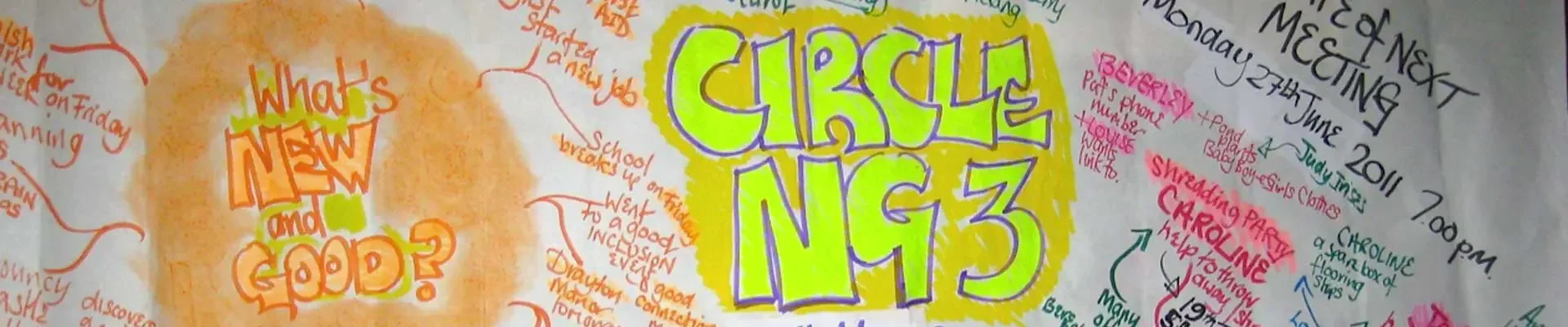
Circle NG3 was created and met for the first time on 1st July 2008. Next meeting 6th August Duke of Cambridge Pub, Woodborough Rd, Nottingham.

7.30-9.30pm All Welcome!


c c ircle

There was a fine sharing of vision for the community we would all love to live in some great exchanges and connections made!

Young people were present and made some wonderful contributions.

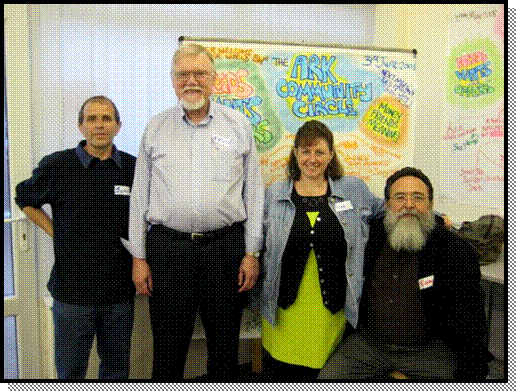
The ARK Community Circle

Our John with David Sahr (Beyond Welfare, Patti Scott-Neighbours, Tom Kohler-Georgia Advocacy)

Look at our special guests at our June meeting!

americans call

Next dates will be in September so watch this space.


'For your interest 21 'allies' attended the first meeting at 'The Ark' Wollaton Avenue, Gedling, Nottinghamshire on Wednesday 21st November, 2007.  We were well supported by Councillors Jim Creamer and James O'Riordon.  
  
The purpose of our meeting was to give an example of how a typical session would work and to explain the Aim, to benefit peoples lives with 'Friendship, Meaning and Money'.  


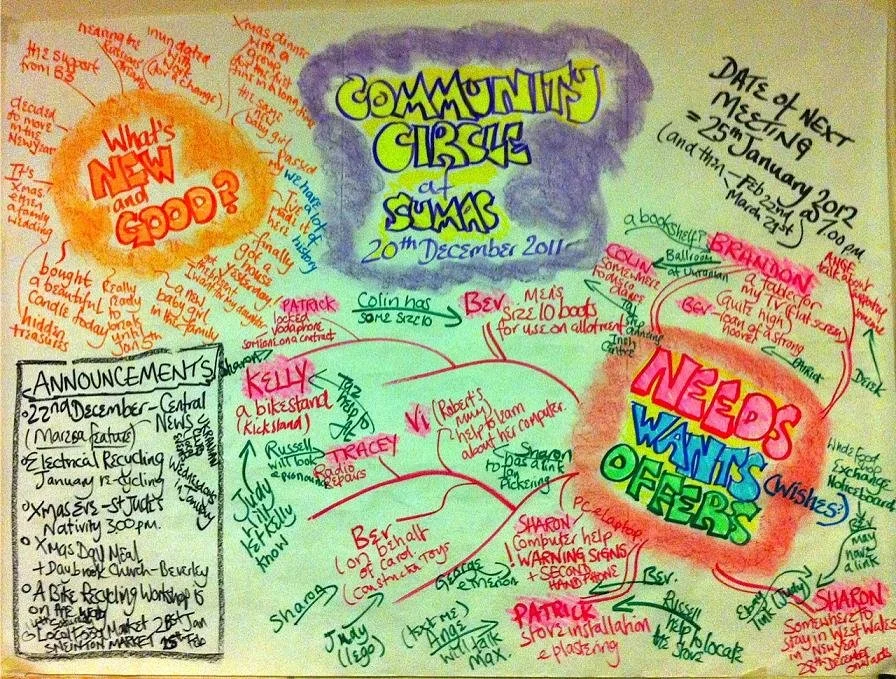
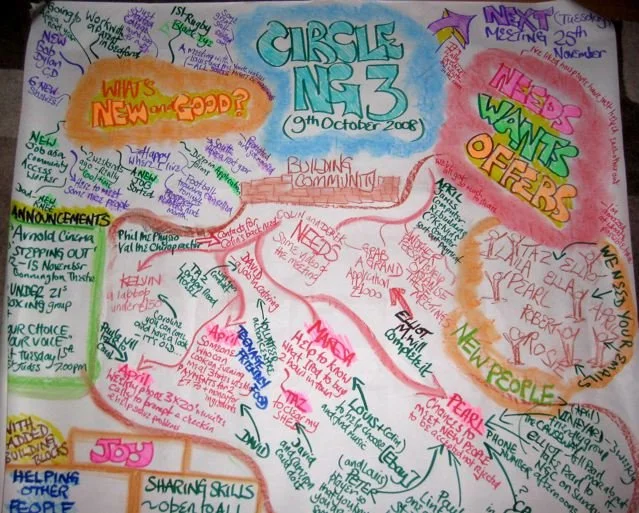
wants needs poster    


A brief description of our evening:  
 

A shared meal,  

  • Circle time of sharing what is 'Good & New' ,   
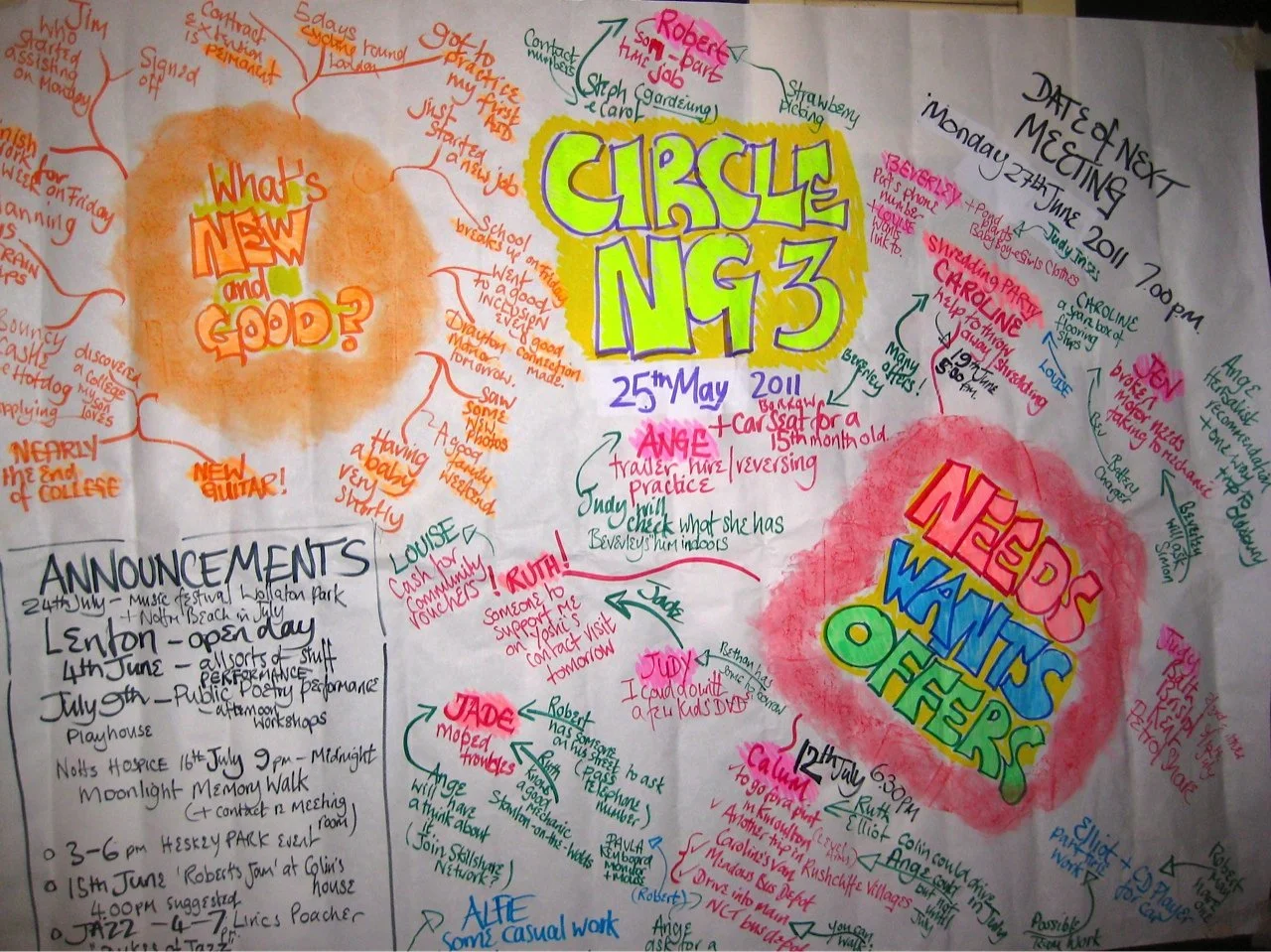
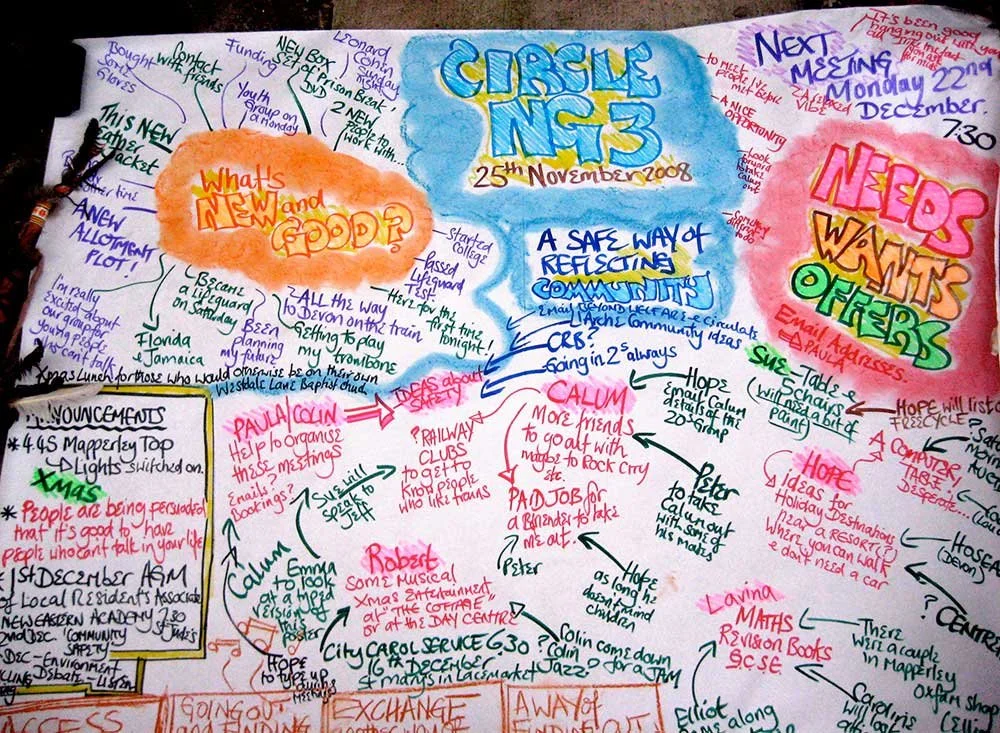
  • People in pairs then discuss their Needs, Wants & Offers.    
  • There was then an invitation to share these with the whole group.

 
Sharing what is 'Good & New' gave a positive safe atmosphere.  

Asking the Question, What Needs, Wants and Offers each had gave an equal reciprocal opportunity.
  
In 20 minutes two direct reciprocal needs and offers were met together with several other offers, needs and wants. There is possiblity to develop smaller circles of support to work on reaching a need or want of a person in a stepped plan.
  
    
We appreciate this was a group of 'Allies' but it gave a striking example of how the process works to bring about 'Friendship, Meaning & Prosperity'.  To reflect the inclusiveness of the group and remove any barriers to who can belong we are suggesting the group is know as 'Community Circle'. (Sue Day)


community circle needs and wants and offers

We have had four more meetings which have been fantastic!   


Beyond Welfare

Web Site
Ames, Iowa
Money, Friends and Meaning

Lois SMdt

Lois at the 2007 Inclusion Summer Institute in Nottingham -


Story County, Iowa has a population of just over 74,000, with the
majority of those folks living in Ames, the county seat and home of Iowa State University. Less than 2% of those residents are people of color. There are 8,336 households in the county with incomes under $25,000. Nothing about those statistics stands out at first glance; Central Iowa is a mostly white place, and rural poverty is often hidden behind that homogeneity. But Story County is also home to a gathering of citizens who call themselves Beyond Welfare, an organization that brings down the walls between the hidden poor and the rest of the community.
Beyond Welfare states its goal simply: eliminate poverty in Story
County by 2020. Ambitious? Maybe. But the manner in which
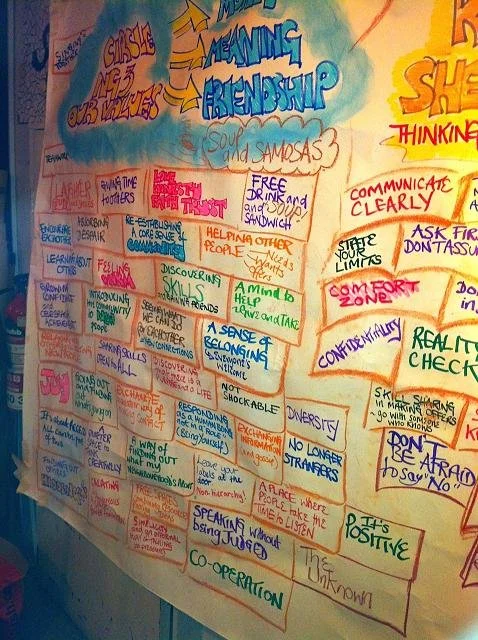
Beyond Welfare is moving toward that goal makes its attainment seem possible. To eliminate poverty, Beyond Welfare is reweaving community; promoting a connected life filled with enough money, friends and meaning for all.
The Beyond Welfare folks call that their mantra—“we all need money, friends, and meaning”. But the inclusive implication of that mantra is startling. Poverty of life and experience can beset those who have enough money, but little meaning and few friends. So, there is something for everyone in the community built by Beyond Welfare.


“Everything We Do Is Intentional”

The founders of Beyond Welfare (BW) have thought long and hard about everything they do. There is a language and process that determines all of their actions. For example, the service-based
language of “client” and “provider” has been replaced by the much more inclusive language of “participant” and “ally”. Becoming part of Beyond Welfare requires the same process for everyone, regardless of role or income.
The BW folks are careful never to stray too far from the citizencentered heart of the endeavor. The very small BW staff is committed to A Community Building Workbook ” 2005 ABCD Institute 9“…community engagement to build the capacity of ordinary unpaid community members to be involved in making Story County a safer, friendlier, and more supportive community for all its members. By engaging “consumers” and the community at large in this way, we strive to build a countywide community
where all of us have enough money, healthy relationships, and a
sense of purpose and meaning.


At the same time we are facilitating relationships that assist and
support individual families, we are building a constituency of
caring for the concerns of families at risk due to poverty and the
harms associated with insufficient income, a constituency for
changing attitudes, human service practice, and policies.” (What
Beyond Welfare Does, Lois Smidt and Scott Miller)
BW is also governed by a local community-lead Board of Directors, constituted by at least 51% members who have been or are currently marginalized by poverty.


Based in Experience
In many ways, Beyond Welfare is the creation of the personal
experience of Lois Smidt, BW co-founder, connector and guiding light. Having spent several years on welfare in the 90’s, Lois is keenly aware of the struggles and pitfalls of trying to raise a family in poverty. Isolation, suppressed anger, stereotypes—all seem to get in the way of even the most determined attempt to overcome them. “Although I certainly had many supportive relationships in my life by this time, as well as community involvement and support, I was still bombarded
with patterns of worthlessness and helplessness that were reinforced by reliance on public assistance and the attitudes projected by human service providers and the general public,” she says.


These two ideas—that relationships are essential and that respectful supportive connections can cross barriers and build
leadership—became cornerstones of Lois’ work and that of BW. She later encountered the concepts of Co-Counseling, or Re-Evaluation Counseling (RC), that provided her with tools and exercises that support her vision. The tools and principles of co-counseling aim to break down the barriers caused by race and class by engaging in the tough work of one-to-one listening and support.

Community Meetings: Beyond Welfare style....


The Community Leadership Team (CLT) Meeting
The CLT meetings begin at 6:00 p.m. with a dinner in the church basement, which
houses a big kitchen and spacious dining room. After dinner, usually around 6:45 p.m., people
load their dishes on a cart to be brought into the kitchen; the child care workers gather the
children into the child care room; the youth and adolescent worker moves his charges into
another room for a program or to do their homework; and the adults go to the meeting room in
the church's main floor for the meeting.
The CLT meeting takes place in a large, comfortable room that has a long wall of
windows overlooking the church's courtyard. Lois usually facilities the meeting. Occasionally,
the Community Resources Coordinator, the psychologist, or a participant facilitate the meeting.
The typical agenda includes: 1) CLT basic purposes and principles; 2) announcements; 3)
updates on what is new and good in participants' lives; 4) advocacy or self-sufficiency work;
and 5) closing appreciations.


1) CLT Purposes and Principles. A brief reminder about Beyond Welfare's purpose and
principles always opens the meetings. Lois first states the purpose of Beyond Welfare, which is
"to ensure that everyone has enough money, meaning, and friends" and reminds participants that
in attending the CLT meeting, they are "advocates for social change" who are there to "learn
what it takes to eliminate poverty." When Lois talks, everyone listens respectfully, even
eagerly, as if her words could make dreams come true. Lois then invites a CLT member to
recite the basic four principles about confidentiality and respect. They are: 1) what is said here
stays here; 2) if you can't say anything nice, don't say anything at all; 3) honor confidentiality
by not introducing others in the group as a Beyond Welfare group member to outsiders without
permission; and 4) show respect by listening to and not gossiping about each other.

2 ) Announcements. The announcements often take up quite a bit of time, covering a
very wide range of topics such as dates/times of upcoming local community events, solicitations
for help with moving, offers to donate household items and requests for household items, and
information about community resources, clothes drives, food pantry access, and new FIP, DHS,
or state policies, regulations, or services. Announcement also may focus on upcoming Beyond
Welfare advocacy events, including providing information, making requests for volunteers, and
planning for car pools.


3) New and Good Update. In my yearly evaluations with CLT members, they always
mention how much they enjoy sharing and listening to updates about something that is new
and/or good in everyone’s lives. New and good updates include descriptions of social activities
people engaged in during the previous week; announcements of new jobs, promotions, or raises;
and updates on school progress or achievements. Sometimes members mention the
accomplishments of their children, such as toilet training a toddler or good grades on a report
card. Members will talk about getting a donated car, a new apartment, a warm winter coat at
Goodwill and their relief at finally having access to energy assistance, housing assistance, or
food stamps. Reports of new and good sometimes describe involvement in a Beyond Welfare
advocacy or speaking for the first time at an orientation for new Family Partners. Sometimes,
the new and good update is a way to, as the expression goes, turn lemons into lemonade, such as
when one CLT member told the group that her “girls did not watch T.V. because the utilities
were turned off." Often, many of the women simply say, "I'm just happy to be here."

4) Advocacy or Self-sufficiency Work. While meetings may vary in style and content, a
typical meeting begins with Lois giving a brief presentation, providing an overview,
explicating a policy, or sometimes, simply articulating the importance of working on a particular
topic. Often, she will then ask the CLT members to form "listening pairs." Listening pairs is a
strategy used in Reevaluation Counseling to help people speak or "discharge" about an issue to a
person who is listening attentively. The format includes each person in the pair discharging for
two-three minutes while the other person listens without comment, judgment, or advice; they
then switch. Lois will ask the CLT members to focus the listening pairs on one or two specific
questions related to her presentation. At the end of the timed listening pairs, Lois brings
everyone's attention back to the circle for group discussion and problem-solving. Standing at
the easel, where butcher paper is mounted for her to write group contributions, she will ask the
CLT members, "Does anyone want to share what you learned in the listening pairs?" As hands
are raised and Lois calls on different people, they only report what they themselves shared, not
what their partner shared. Lois responds to each members' contribution by affirming them
verbally and writing down what she/he said. When the contributions and discussion are
exhausted, Lois will draw some conclusions for the group to reflect upon or, depending on the
topic, the group may decide upon a plan of advocacy.


5) Closing Appreciations. To draw the CLT meeting to a close, CLT members go
around the circle saying something positive to the person to her right. Often the time is short at
the end of the meeting, so appreciations are kept to one or two words. If the group is small or
when there is ample time, more is said. A sampling of appreciations from a range of evenings
includes, "you are a strong and quick thinker," "you are accepting and gentle," "fun," "kind,"
"good listener," “I appreciate the support you give me," "your smile," "nice," and “I appreciate

how you keep up with things and do so much."

We at Inclusive Solutions have met and worked with Lois and simply love Beyond Welfare.

Focus on Community Capacity not Deficit

We now often work with this idea in our training around challenging behaviour and inclusion. Recruiting well connected community members to link up with vulerable or isolated individuals or families and to build circles of support or connection around them using their contacts but NO paid professionals or experts. A free 50 page book that describes one approach to this idea is available from the ABCD Institute and you can download it ..... Hidden Treasures:Building community connections by engaging the gifts of people on welfare, people with disabilities, people with mental illness,
older people and young people.


ABCD In Action By Mike Green, Henry Moore & John O’Brien

abcd community book

ABCD in Action Book and DVD profiles five diverse groups who have utilised the principles of ABCD to create partnerships with those they serve and in effect, rejuvenate and revitalise their organisations.

Included are profiles from:

•Neighbourhood associations in Savannah, Georgia

•Beyond Welfare, an organisation supporting people in poverty in Ames, Iowa

•The Archdiocese of Upper Michigan in Marquette, Michigan

•Lakes Region Community Services Council, supporting people with disabilities in New Hampshire

•Neighbourhood Housing Services, an organisation providing affordable housing opportunities in Asheville, North Carolina.

Plus extensive interviews and commentaries by Mike Green, Henry Moore and John McKnight.

A very linked community to this way of thinking can also be found at:

The Freeconomy Community which is about sharing the skills you've learnt throughout your life and learning those you haven't. It's about helping others and providing an opportunity for others to help you. Freeconomy allows people to make the transition from a money based communityless society to more of a community based moneyless society, and to share the land they don't need or can't use to facilitate a local food community.

It's about making the transition from a money-based communityless society to a community-based moneyless society.
It's about helping others and providing an opportunity for others to help you.
It's about sharing the skills you have learnt through your life and learning those you haven't.
It's about sharing your tools so you all can have access to all the tools under the sun without it costing the earth.
It's about using any free space you have to either benefit positive, ethical and local projects, or to enable volunteers to keep doing their amazing work for free.
It's about sharing the land you don't need in order to facilitate a local food community.
It's about freeconnecting neighbours.
It's about learning to help each other again.
It's about getting ready for a post peak oil world.
It's about making dinner for a friend who was yesterday a stranger.
It's about keeping money out of the equation.
It's about communicating face-to-face and phasing out technological communication.
It's about putting the soul back into society.
It's about helping each other not for profit, but just for the love-ofit.

Nottingham Freecycle can be joined here is open to all who want to "recycle" that special something rather than throw it away. Whether it's a chair, a fax machine, board game or an old door, feel free to post it. Or maybe you're looking to acquire something yourself! Non-profits are also welcome to participate. Join in and have fun gifting! Everything posted must be free, legal and appropriate for all ages.

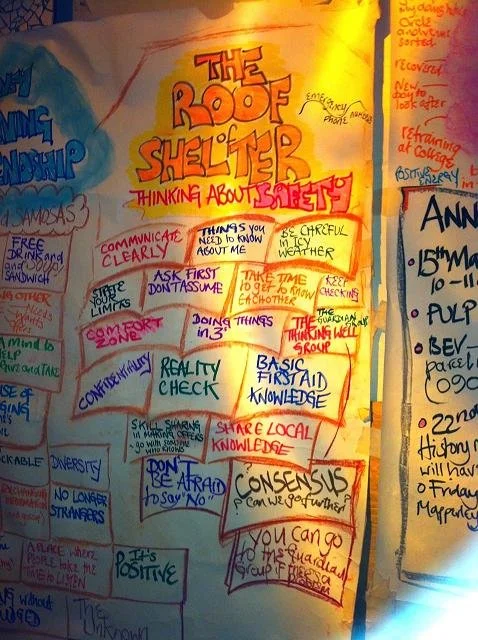
community circle garphic

Connecting People

Check out this great article: Connecting People, a new approach to advocacy through a BILD project - community connecting through advocacy, and a community team helping people and their families develop their involvement in community life. This is an an article by Clare Wightman, Director - Grapevine (Coventry and Warwickshire) Ltd recently published in Learning Disability Today about their work.

'To be successful we have to start from a belief
in inclusion. A belief that:
we are all born ‘in’
all means all
everyone needs to belong
everyone is ready
everyone needs support
everyone can communicate
everyone can contribute
together we’re better.'

Who could argue?

woman with coffee

Making good use of Third Places

'This term was coined by Ray Oldenburg in his
book The Great Good Place: Cafes, coffee
shops, bookstores, bars, hair salons (1999).

Oldenburg is an Urban Sociologist from Florida
who writes about the importance of informal
public gathering places. ‘Third place’ simply
refers to associations or connections between
people that are based on locations, like
becoming a regular in a cafe or bar. A third
place is a place of belonging, somewhere
that is comfortable, and conversation is the
main thing, a place where you can get known
without doing much. There are no qualifications
needed and no criteria to be met. It is
important to go at regular times, which works
well for people who enjoy routine. We have
learned that this method of connecting cannot
be used casually though – you have to be
active not passive in your support as you
need to spot opportunities for interaction and
relationship building. We have helped people
with high support needs to become regulars
of local places.'

(Whightman- as above)


graphic of community Circle

Community Circle Meetings

Next session with Allies and Participants is on Tuesday 3rd June 2008, 6.30- 8.30pm at the ARK in Wollaton Ave, Gedling, Nottinghamshire.... '
 

David Sahr from Beyong Welfare will be there!
 
If you are able to attend or would like to bring along someone who would benefit please us know.'


Donate money now to support Inclusive Solutions in their Community Building Work